The systems behind modern AI software.
A production-grade learning environment for knowledge graphs, RAG, agents, and MLOps. Build in runnable labs, validate instantly, and navigate a live concept graph where prerequisites stay visible.
From first triples to GraphRAG pipelines.
Live curriculum graph
concepts · labs · validations
MATCH (learner)-[:COMPLETES]->(lab)
WITH learner, collect(lab) AS evidence
MATCH (lab)-[:VALIDATES]->(concept)
RETURN learner, concept, size(evidence) AS confidence
How it works
Screens from the actual platform — not mock-ups. And a free lab you can open right now.
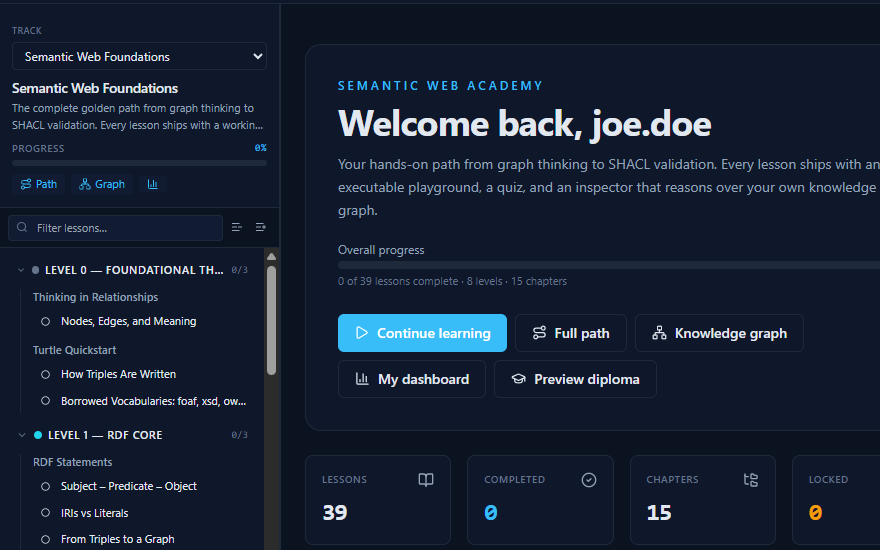
Guided path
Unlock lessons as you complete the previous one. Sections check themselves so you always know where you stand.
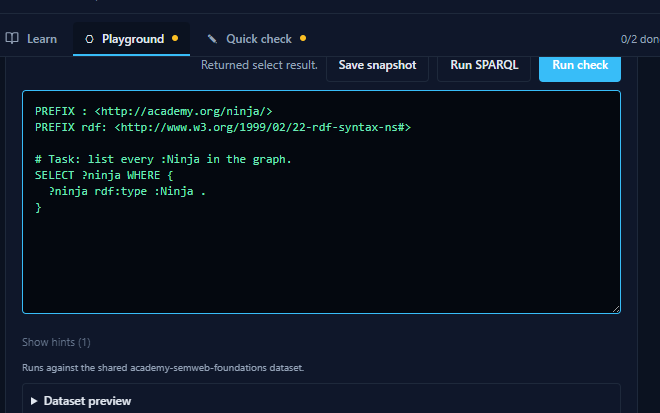
Real playgrounds
Every lesson ships with an interactive editor — Turtle, SPARQL, SHACL, or code. Run, validate, iterate.
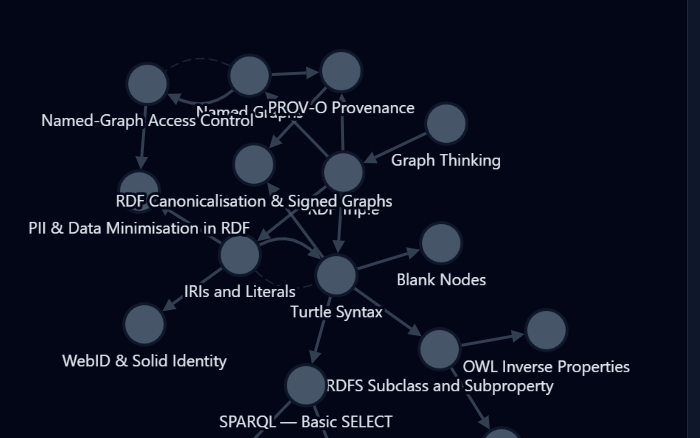
Concept graph
Your knowledge graph grows alongside the curriculum — concepts, prerequisites, and progress in one place.
The Laboratory
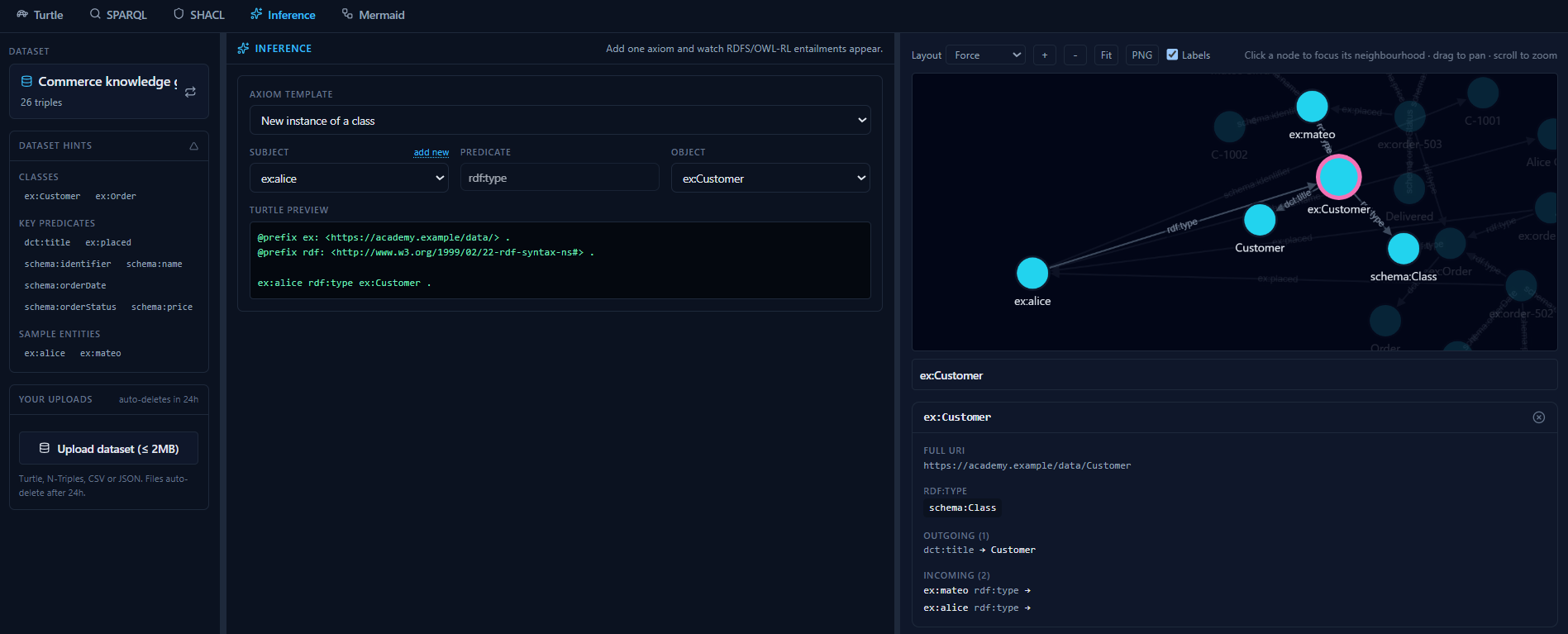
A production-grade playground: query real sample knowledge graphs with SPARQL, validate with SHACL, add a single axiom and watch an OWL reasoner infer new facts — with every inference explained in plain English. Nothing to install.
- Turtle
- SPARQL
- SHACL
- Inference
- Mermaid
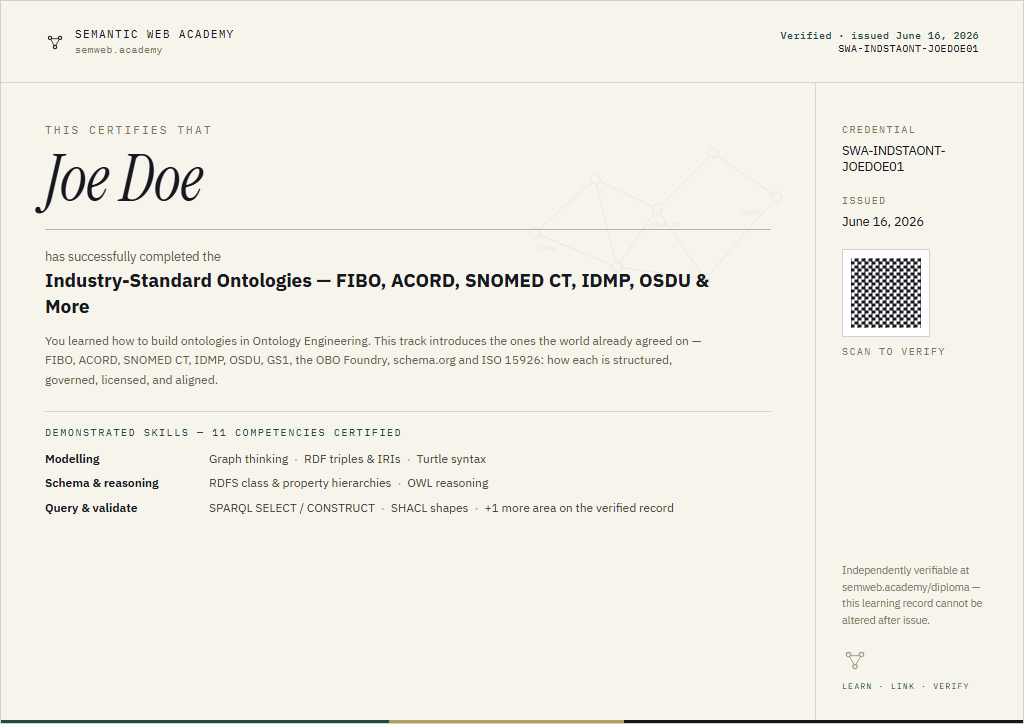
Register now and earn a completion certificate at no cost.
Start with the full learning path for free, work through runnable lessons in the academy, and unlock a shareable certificate when you finish the track. No paywall for the core curriculum, no watered-down demo tier.
Free core platform
Visitors can register and start the academy without a paid gate blocking the main path.
Certificate included
Completion unlocks a certificate that formalizes progress across the learning track.
Trustworthy learning loop
Lessons, checks, progress, graph context, and certification all live in the same system.

New · AI course builder
Generate a private course tailored to your level.
Tell us what you want to learn, your level, your audience and your goal — we plan, compose, critique and ship a complete curriculum with runnable labs. Every input is binding: a beginner course and an advanced course on the same topic look measurably different.
Course generation runs on per-user quota — ask an administrator to grant yours.
Calibrated to your level
Beginner gets scaffolding and small examples. Advanced opens with edge cases and 30–80-line snippets.
Critic-validated
A second LLM pass rejects content that drifts off-level or fails to advance your goal.
Fully integrated
Generated tracks render in the same IDE, with runnable labs, progress, and a diploma at the end.
Choose your track
Each track is a complete curriculum. Pick where you want to start — you can switch any time.

Semantic Web Foundations
From your first triple to production-grade SHACL shapes — a hands-on path through the four pillars of the Semantic Web.
Start this track
Software Architecture & Domain-Driven Design
Model your domain. Defend its boundaries. Compose services that stay shaped like the business — even when the business changes.
Start this track Intermediate
Knowledge Graphs, Retrievals & LangGraph
From triples to multi-agent retrieval
Move past naïve RAG. Combine a knowledge graph, vector retrieval and a state-machine orchestrator into a system that knows what it knows — and what to do when it doesn't.
 Beginner → Advanced
Neo4j & Cypher
From your first MATCH to production tuning
Think in patterns, not joins. Learn the property-graph model Neo4j uses, write Cypher that reads like an ASCII drawing of your data, and ship it through indexes, query plans and the official drivers.
 Beginner → Advanced
Data Management & Governance
From bytes to policies, with analogies
Learn to tell apart structured, semi-structured and unstructured data; pick the right model; install quality, lineage and governance; and ship the result on lake / warehouse / lakehouse / mesh — without losing sight of the people and policies.
 Beginner → Advanced
DAMA-DMBOK Body of Knowledge
The DMBOK Wheel, end to end
Walk the entire DMBOK Wheel — Governance, Architecture, Modeling, Storage, Security, Integration, Documents, MDM, Warehousing, Metadata, Quality — with strong analogies and operational deep dives. Finish with a maturity assessment you can run on your own platform Monday morning.
 Intermediate → Advanced
Industry-Standard Ontologies — FIBO, ACORD, SNOMED CT, IDMP, OSDU & More
The standards employers name by name
You learned how to build ontologies in Ontology Engineering. This track introduces the ones the world already agreed on — FIBO, ACORD, SNOMED CT, IDMP, OSDU, GS1, the OBO Foundry, schema.org and ISO 15926: how each is structured, governed, licensed, and aligned.
 Intermediate → Advanced
Apache Kafka & Streaming Systems
Brokers, schemas, Streams, ops — Python + Go
Stop polling, start streaming. Learn the partitioned commit log that powers event-driven systems at scale — and the operational muscle you need to actually run one in production.
 Beginner → Advanced
Ontology Engineering
From philosophy to production OWL
Learn what an ontology actually is, why RDFS isn't enough, how OWL and Description Logic let reasoners do real work, when SHACL beats OWL, and how to ship a versioned, FAIR-published ontology your downstream consumers can trust.
 Beginner → Advanced
MLflow End-to-End: Track, Package, Register, Serve
Track runs, package projects, version models, deploy with confidence
Stop losing experiments to notebook chaos. Learn the MLflow workflow that grown-up ML teams use: track everything, package your code, version your models, and serve them through a registry that you (and audit) can trust.
 Beginner → Advanced
MLOps: Production Machine Learning Systems
From notebook hero to production team
ML models that ship are 5% modelling and 95% systems. Learn the patterns, hand-offs and feedback loops that take a model from a lucky notebook to a service your business can rely on — without drowning in vendor speak.
 Beginner → Advanced
Data Engineering — From Pipelines to Platforms
Pipelines, warehouses, lakehouses, contracts
Most 'data' careers drown in tools. This track gives you the mental models — batch vs streaming, OLTP vs OLAP, row vs columnar, push vs pull orchestration — then layers tools (Spark, Airflow, dbt, Iceberg, Flink) on top so you can swap vendors without losing your footing.
 Intermediate → Advanced
Cloud Data Platforms — Snowflake, Databricks & BigQuery
Snowflake · Databricks · BigQuery, head to head
You learned the vendor-neutral fundamentals in Data Engineering. Now meet the platforms that implement them. This track decodes how Snowflake, Databricks and BigQuery each separate storage from compute, how they bill, where they shine, and how to pick — and migrate between — them without religion.
 Intermediate → Advanced
Semantic Layers — From Metrics to Meaning
Metrics-as-code, headless BI, ontology-driven analytics
Every team writes its own SQL for 'revenue' and ships five different numbers. This track teaches the layer that fixes it: metric trees, dbt SL, Cube, LookML, and the bridge to ontology-driven analytics — one definition for BI, apps, reverse-ETL and LLM agents.
 Intermediate → Advanced
AI & Data Security: Governance, Access Control & Agent Guardrails
From SHACL shapes to policy enforcement points
Secure the graph and the agents that query it. Build layered controls from validated RDF inputs through identity-aware authorization to tamper-evident audit trails and guarded tool execution.
 Intermediate
Bridging RDF/OWL and Property Graphs
Two graph models, one source of truth
Keep RDF/OWL as a governed semantic contract while materializing the right operational graph, search, or retrieval projection for production.
 Intermediate
Upper Ontologies & Fallback Options
When a foundational ontology earns its keep — and when it doesn't
Upper ontologies are powerful and frequently over-adopted. Learn the core distinctions, compare BFO/DOLCE/SUMO/gist honestly, and master the fallback ladder so you buy exactly as much foundation as your competency questions justify.
Popular topics
A sample of the curriculum. The full catalogue is searchable and filterable on its own page.
- graphsLevel 0 — Foundational ThinkingBuild semantic intuition and learn just enough syntax before Level 1.3 lessons · 1 h
- rdfLevel 1 — RDF CoreEvery fact in the Semantic Web is a triple. Learn the atom.3 lessons · 1 h
- turtleLevel 2 — Turtle MasteryWrite fluent, compact Turtle — the human-friendly RDF syntax.4 lessons · 1 h
- rdfsLevel 3 — RDFS & Lightweight ReasoningHierarchies of classes and properties — the first step into inference.3 lessons · 1 h
- owlLevel 4 — OWL & InferenceExpress richer semantics: inverse, equivalent, transitive, symmetric.3 lessons · 1 h
- sparqlLevel 5 — SPARQL Query LanguageFrom basic graph patterns to professional querying: joins, OPTIONAL left-joins, negation, aggregation, property paths, subqueries, and the evaluation semantics that decide whether a query is correct *and* fast.13 lessons · 3 h
Ready to see it for yourself?
No account needed for the first lesson. Run real Turtle in the browser and validate it instantly.